
Fatal Convergence
The Potomac River Mid-Air Collision.
We are going to talk about an in-air collision that occurred between a passenger jet and a helicopter. The passenger jet was a Bombardier 700 CRJ with 64 people on board 5342, and a Black hawk, helicopter belonging to the US army, with 3 people on board, PAT25.
The CRJ flight 5342 was making an approach to Ronald Regan Washington National (DCA) Airport. The helicopter flight was conducted for the purpose of the annual standardization evaluation of the pilot with the use of night vision goggles.
Sequence of events-
2043:06 Flight 5342 contacted DCA tower, they were 10.5 Nautical Miles from DCA, making an approach to Runway 01. Tower controller asked if the crew could switch to Runway 33 instead. The crew agreed and the controller subsequently cleared flight 5342 for landing on Runway 33.
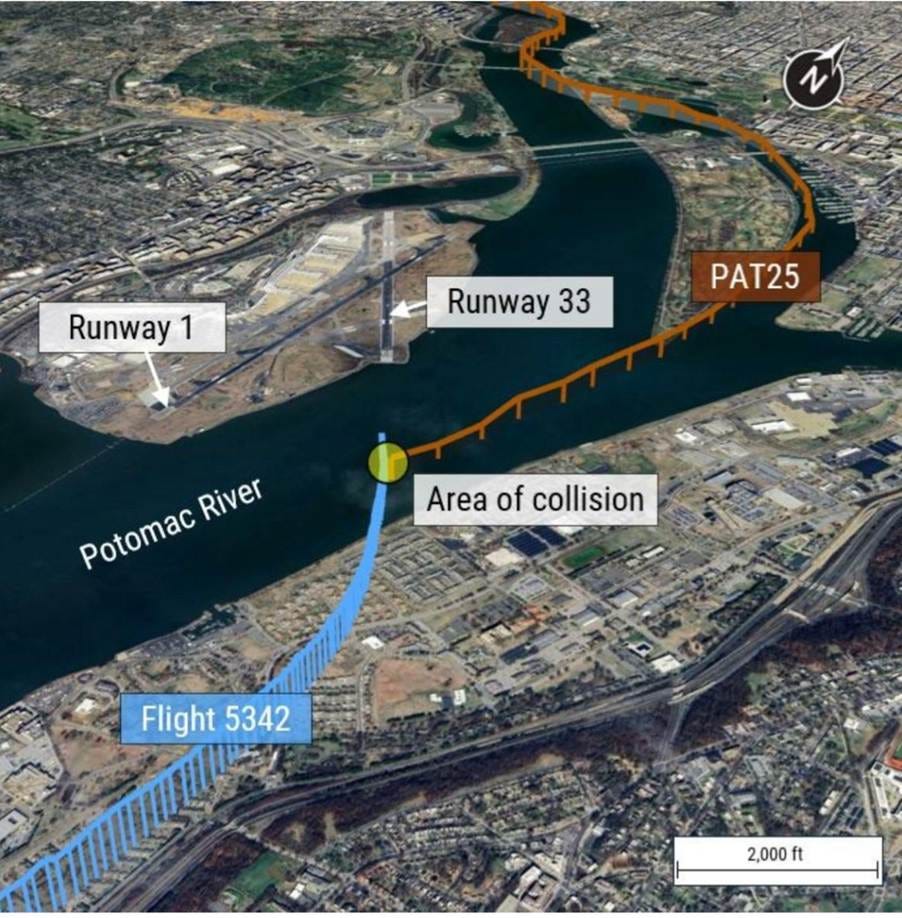
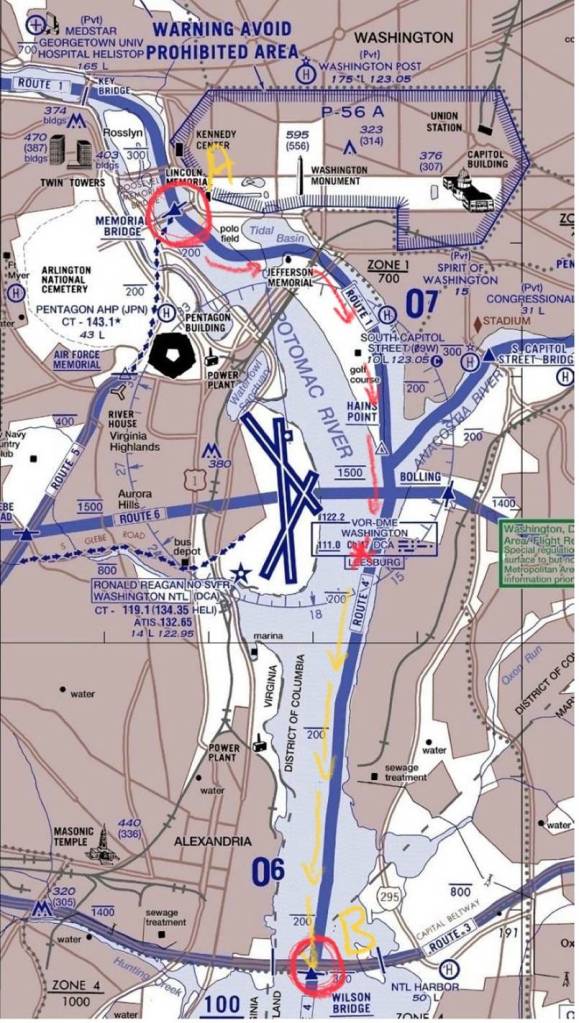
2045:14 PAT 25 crossed the memorial bridge, which is the beginning of Route 1. (Point A) They were at 300 feet.
(The helicopter was cleared Route 1 followed by Route 4, points A and B marked on the map below. Between these two points the stipulated altitude to be flown was 200 feet)
2046:02 Tower informed PAT 25 of a traffic CRJ, that was circling to land on Runway33.
2046:08 The Black hawks crew reported that they had the traffic in sight, and they would maintain visual separation. At this point both the aircraft were 6.5 nautical miles apart.
2047:27 PAT 25 reaches Hains Point.
2047:28 Flight 5342 began a left roll on to finals for Runway 33. The airplane was at 516 feet with a speed of 133 knots.
2047:39 20 seconds before impact ATC was heard asking the crew of PAT 25, if the CRJ was in sight. A conflict alert is heard in the background.
2047:40 Traffic alert and collision avoidance system (TCAS) alerted TRAFFIC TRAFFIC. At this point both the aircraft were .95 Nautical miles apart.
2047:52 Flight 5342 rolled out on final approach for Runway 33. The airplane was at 344 feet and 143 knots.
2047:59 The collision occurs.
2 secs before the collision, the aircraft’s recorded altitude was 313 feet, with a 9 degrees nose -up attitude and a 11-degrees left bank, descending at 448 feet/minute. The helicopter was 278 feet.
While the helicopter pilots likely bear responsibility for exceeding the stipulated altitude. Route 1 required an altitude of 200 feet to be maintained. To fully understand the contributing factors, let’s analyze the accident using SHELL model. Applying the SHELL model framework helps analyze the broader systemic issues rather than just placing the blame on the pilots.
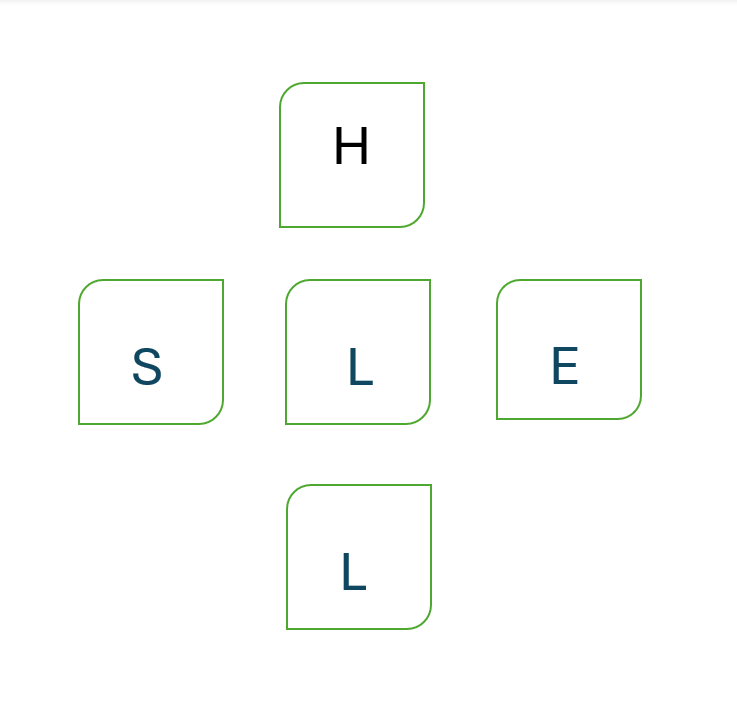
The Shell Model
S: Software
H: Hardware
E: Environment
L: Liveware
Let us look at the event through the lens of the SHELL model.
H: The hardware, both the aircraft, the CRJ and the helicopter were in perfect flying condition. Another important piece of hardware responsible for the event was the NVG (Night Vision Goggle).
NVG’s are used in low light conditions, it amplifies the light entering into the retina to enhance the vision at night. It does so by creating a monochromatic image, which makes judging distances more difficult it difficult. At the same time, it also creates a monocular image making it very difficult for the human brain to calculate distances. The Helicopter crew were flying a visual flight plan, relying on visual cues. However, in this case, those visual cues were compromised, making it difficult to judge distances.
TCAS 2 version 7.1. TCAS 2 is mandated equipment for all aircraft with more than 30 seats and weighs more than 33000 lbs.
TCAS indicates
Traffic Advisory-In the form of aural alert-TRAFFIC TRAFFIC.
Resolution Advisory-By indicating CLIMB or DESCEND to avoid the traffic.
In this case the aircraft was below 900 feet, after which TCAS inhibits RA, it issues only TRAFFIC ADVISORY when the traffic is 20 seconds from the closest point of approach or .3 NM whichever is earlier.
S: Software, the rules and regulations put in place. In this case, the rules for flying in the airspace were set at below 200 feet. This rule was not followed by the helicopter crew, probably because of inattention or due to the aided vision of the NVG which would make reading the instruments inside the cockpit difficult.
L: Liveware is Human involved (it’s repeated twice to indicate Human to Human interaction).
The CRJ was asked to switch from Runway 01 to Runway 33, while not error in itself, placed the CRJ right in the path of the Helicopter.
E: Environment, between 2011 and 2024 a vast majority of reported events had occurred, with one RA event per month. In half the events the helicopter was above the stipulated altitude. Two-thirds of the event occurred at night.
Between October 21 and December 24, DCA airport had 944179 operations. During this time there were 15214 occurrences where lateral separation was less than 1NM and vertical separation of less than 400 feet, between commercial airplanes and helicopters. There were 85 recorded events of lateral separation less than 1500 feet and vertical separation less than 200 feet.
The statistics highlighted persistent risks which were not fully addressed. Rather than solely blaming the pilots, this accident highlights the dangers of reducing safety margins and ignoring persistent threats. Without addressing these systemic vulnerabilities, similar tragedies will continue to occur.
 Rohit kumar
Leave a comment